
Industrial coating applications / Concrete Protective Coatings / Battery Charging Area Floor Coatings
Identify the battery technology and actual floor exposure
A charging-area label does not describe a single chemical duty. Identify the battery technologies, handling arrangements and maintenance activities in the area. Provide current safety data sheets for substances that could reach the floor, including cleaning products, and explain whether the anticipated contact is incidental splash, a maintenance spill or a different service condition. Concentration, temperature and contact duration can matter to coating selection; the responsible specifier or approved manufacturer should review the actual duty.
Do not assume a floor product selected for one charging installation is appropriate for a different battery system or cleaning routine. Include any planned equipment changes. The coating is one part of the work-area protection strategy, while battery management, charging equipment, ventilation, electrical provisions and emergency arrangements remain separate facility responsibilities. A green or glossy finish by itself does not establish chemical resistance or overall charging-area suitability.
Map the charging position and surrounding traffic
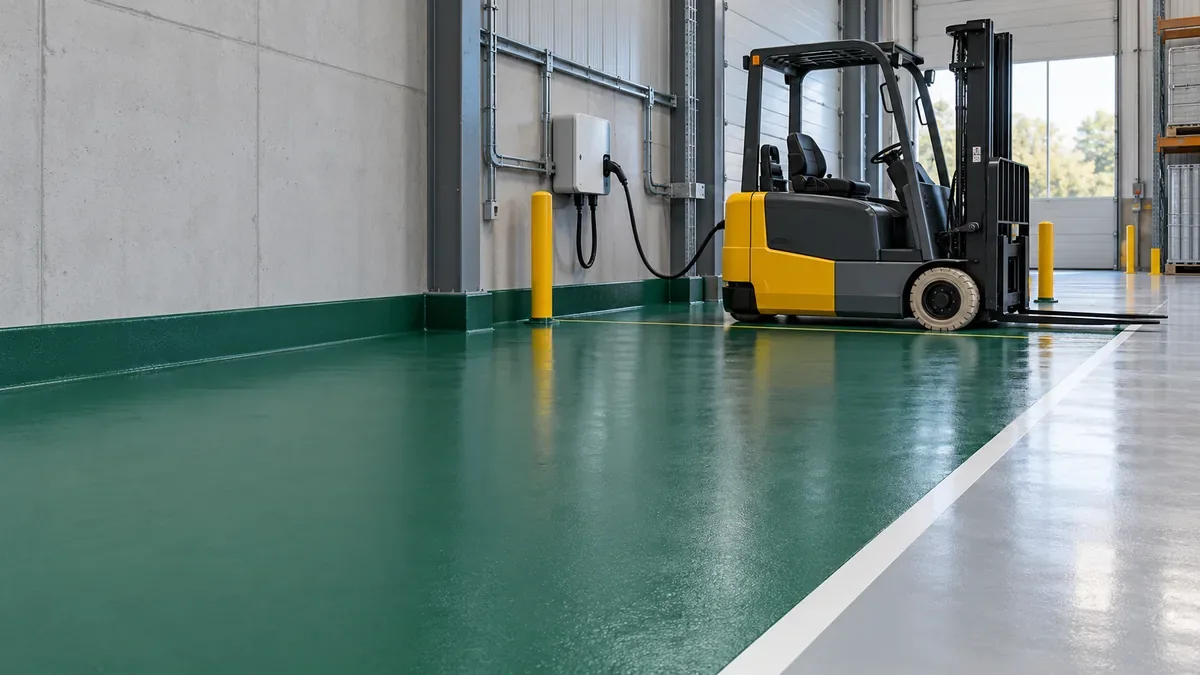
Draw the work zone around the charger, parked equipment, battery-handling position, cleaning area, accessible aisle and nearby storage. Mark where the coating starts and ends, which surfaces receive an upstand or cove, and whether traffic markings are part of the request. A small equipment footprint may still require a larger preparation and protection area to provide workable edges and avoid an untreated strip beneath a fixed installation.
Describe forklift movements, turning, braking, parked loads and pedestrian use. These conditions influence the approved system and maintenance expectations. Traffic should not be described only as light or heavy without explaining the equipment and routine. If the project requires a change to charging layout, guarding or traffic management, assign those decisions to the responsible facility team before finalizing the coating boundaries.
Review concrete condition beneath the existing finish
Survey cracks, deteriorated concrete, previous repairs, stains, existing coatings and sealers. Photograph the edges of coating failures as well as the broad floor. Residues beneath equipment, at walls and near drains may need particular attention during cleaning and assessment. The approved preparation method must produce the substrate condition required by the selected system; simply covering a stained surface does not establish that it is ready for a new coating.
Moisture history, weak concrete and recurring leakage should be disclosed before pricing. A surface coating should not be presented as a universal repair for these conditions. The specification and product documents determine the appropriate investigation, repair and acceptance route. Where the existing finish is unknown, identify how compatibility and removal requirements will be resolved rather than assuming that an additional coat can be applied over every intact-looking area.
Separate floor coating from containment and joint design
Identify curbs, thresholds, joints, penetrations, equipment anchors and any drainage interfaces. State which details receive the coating system and which require a different approved material or separate work. A moving joint may need treatment that differs from the surrounding rigid floor coating. The design should establish the intended function of each interface rather than relying on a continuous-looking finish to perform every sealing or movement role.
Where the facility requires spill containment, the responsible project team must define capacity, geometry, terminations and other design requirements. A coated slab alone does not verify that the area meets those requirements. Changes to slopes, curbs, drains or concrete levels should be assigned separately where needed. Include their completion and substrate release in the schedule so coating is not installed before related work is resolved.
Choose texture and markings for cleaning and use
Review expected contamination, wet cleaning, footwear and vehicle traffic when the approved finish is selected. Texture, cleanability and chemical exposure need to be evaluated together. A rougher surface can affect cleaning effort, while a smooth appearance is not automatically appropriate for every working condition. Use the specified system and finish criteria rather than promising that one texture removes every slip risk in a maintained industrial work area.
Color zones, aisle lines and equipment-position markings should be measured and specified separately. Confirm their compatibility with the floor system and the owner's maintenance requirements. If the charging position may move later, discuss how markings and coating terminations should be maintained. The quotation should distinguish the protective system from optional layout painting so the owner can compare the actual quantities and responsibilities.
Define the coating scope before pricing
Send the battery types, chemical and cleaning information, floor photographs and a marked work-area plan. Include charging access and shutdown constraints so preparation, product review and the restart sequence can be priced on a defined basis.
Coordinate equipment release and phased access
The facility's authorized team controls charger isolation, equipment movement and release of the work area. Identify who removes or protects chargers, cables, cabinets, guards and other fixed items. State which concrete surfaces remain inaccessible. Preparation and inspection tools need practical clearance; an equipment footprint drawn on a plan is not automatically a reachable coating area when the equipment remains installed.
If charging access must continue elsewhere, the owner should identify the alternate arrangement and traffic boundaries. A phased coating plan needs separate preparation limits, termination details and protection from adjacent operations. Repeated mobilization and temporary boundaries can affect cost and schedule. Dominant Service & Supply, LLC works at customer facilities and job sites from its Harvey, Louisiana operating base; work-area releases are coordinated directly for the particular facility.
Allow for the complete cure and restart sequence
The available window must include cleaning, repairs where specified, surface preparation, each required coat, cure and inspection. Return to foot traffic, placement of equipment, forklift turning and chemical exposure may have different release requirements. Use the current approved product information for the actual conditions instead of treating a dry surface as ready for every operating activity. Ventilation and environmental conditions can also affect the work sequence.
Agree how the finished surface will be protected during charger reinstatement and equipment return. Wheels, supports and tools can damage a new finish if handling occurs too early or without protection. Identify who authorizes each release and how defects or later damage will be recorded and repaired. The coating completion package should state remaining restrictions clearly so the operating team can restart the area on the agreed basis.
Request a quotation with measurable work boundaries
Provide a marked plan, floor dimensions, photographs, battery and chemical information, cleaning routine, current finish details and the proposed shutdown. Measure vertical returns, curbs, joints and line markings separately from floor area. Assign concrete repair, isolation, equipment movement, containment changes, access and waste handling responsibilities. These details help distinguish a complete installation scope from a simple material allowance or a price that excludes difficult interfaces.
Agree the inspection and closeout requirements with the approved system. They may include substrate acceptance, material identification, environmental checks, application records, required thickness verification and repair documentation. Keep the records tied to the charging zone and actual termination details. Call or text 504-579-4330, or use the project quote form, to review the floor-coating request and identify information needed before final pricing.
Battery Charging Area Floor Coatings FAQs
Is one coating suitable for every battery-charging area?
No. Battery technology, potential chemical exposure, cleaning products, concrete condition and traffic can differ. Provide the actual duty for review against the approved coating system. The general term battery area is not enough to establish chemical compatibility, preparation requirements or the finish suitable for the installation.
What chemical information should accompany the request?
Identify battery types, maintenance substances, potential spill materials and cleaning products. Supply current safety data sheets and describe concentration, temperature and likely contact duration where relevant. Include planned operational changes so the system is reviewed for the service the facility expects to use.
Does coating the floor establish containment compliance?
A coating may be part of a specified protection system, but containment geometry, capacity, joints and interfaces require the appropriate project review. Do not treat the presence of a coated floor as proof that all facility, engineering or regulatory requirements have been met.
Can the floor be coated around installed chargers?
The available access must be reviewed. Identify what can be isolated, moved or protected by the owner's authorized team and which concrete remains concealed. State inaccessible areas in the work boundaries. Surface preparation and inspection need enough clearance to perform the approved work properly.
Will the coating repair existing concrete damage?
Only the separately defined substrate-repair work is included. Weak concrete, active cracks, recurring moisture or leakage may need additional investigation and an approved repair approach. Resolve substrate acceptance before coating rather than assuming a new finish restores the slab or corrects an underlying condition.
Can an existing coating remain beneath the new system?
That depends on condition, compatibility and the approved specification. Identify the existing finish and cleaning history where possible. The review should establish whether cleaning and local preparation are adequate or removal is needed, including any project-required checks before the new system is extended across the area.
Are joints and equipment anchors coated continuously?
Follow the approved details for each interface. A moving joint, fixed anchor and wall termination can have different requirements. The floor system should not be assumed to replace joint sealants or other specialized treatments. Measure and assign these details explicitly in the quotation.
How is floor texture selected?
Consider walking conditions, contamination, cleaning and equipment traffic with the approved system requirements. Texture and cleanability affect one another. The specification should state the intended finish and acceptance approach without claiming that a single surface texture prevents every slip or maintenance problem.
Can aisle lines and charging-position markings be included?
Yes, they can be reviewed as a defined part of the request. Provide colors, dimensions, layout and the owner's identification requirements. Confirm compatibility with the protective floor system and distinguish marking quantities from the base coating area so future layout changes can be maintained clearly.
How quickly can forklifts return to the area?
Use the approved system's cure and traffic-release requirements for the actual application conditions. Foot-traffic readiness does not necessarily establish readiness for loaded wheels, turning or chemical exposure. Agree the restart stages before committing to a shutdown window and protect the finish during equipment reinstatement.
Does Dominant supply or certify charging equipment?
This request concerns the concrete coating scope. Charger supply, electrical servicing, battery procedures and equipment compliance remain with the appropriate owner representatives and qualified service providers. Identify their interfaces during planning so coating work is coordinated with the facility's authorized operating and maintenance arrangements.
How do we start a charging-area floor coating request?
Send a plan, photographs, dimensions, battery information, chemical duty, existing finish and the target schedule through Request a Quote. Call or text 504-579-4330 for an initial discussion. Dominant Service & Supply, LLC reviews work at customer facilities and job sites, with logistics confirmed directly for the project.
Related coating services and next steps
Discuss your coating project
Dominant Service & Supply, LLC serves Gulf Coast customer facilities and job sites from Harvey, Louisiana. Call or text 504-579-4330, or send the project details for a scoped quotation.